Professional Practice
Botanical illustration is a communication and scientific tool that supports the research of botanists and horticulturalists to accurately and meticulously depict and record the appearance and growth cycle of plants.
In this field, there are many outstanding illustrators, each with their style.

Franz Bauer's artworks, predominantly rendered in watercolour and meticulously hand-coloured, have set a standard both in terms and style due to their immense scientific value.
Fig. 1, From "Illustrations of orchidaceous plants" by Francis Bauer; with notes and prefatory remarks by John Lindley
Marianne North breaks away from traditional botanical painting by employing oil paint as her medium. Her works deviate from the conventional light colour backgrounds seen in botanical illustrations, instead focusing on intuitively conveying the habitat of plants while highlighting their unique characteristics.
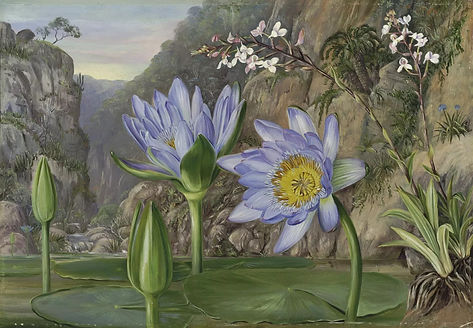
Fig. 2, Nymphaea stellata, South Africa by Marianne North © RBG Kew
%20from%20%E2%80%98The%20Kew%20Book%20of%20Botanical%20Illustration%E2%80%99%20by%20Christabel%20King_j.jpg)
Christabel King uses traditional media such as watercolour and colour pencils to create clear and high-quality illustrations that aim to convey comprehensive information about her subject matter.
Fig. 3, A page spread (pp.74-5) from ‘The Kew Book of Botanical Illustration’ by Christabel King
Although these artists’ stylistic mediums vary, they all adhere to the fundamental principles of botanical illustration: scientific observation, accuracy, and meticulous attention to detail that photography cannot replace.
“The best botanical illustration successfully combines scientific accuracy with visual appeal. It must portray a plant with the precision and level of detail for it to be recognised and distinguished from another species.” (RHS, 2020)
Sources
Fig. 1 Bauer, F. and Lindley, J. (1838) From “Illustrations of orchidaceous plants” by Francis Bauer; with notes and prefatory remarks by John Lindley, 36259093. Biodiversity Heritage Library.
Available at: https://www.biodiversitylibrary.org/pageimage/36259093 (Accessed: 24 April 2024).
Fig. 2 North, M. (1883) Nymphaea stellata, South Africa by Marianne North © RBG Kew, Things you should know about Marianne North, Royal Botanical Gardens Kew.
Available at: https://www.kew.org/read-and-watch/marianne-north-botanical-artist (Accessed: 24 April 2024).
Fig. 3 King, C. (2016) A page spread (pp.74-5) from “The Kew Book of Botanical Illustration” by Christabel King, providing advice on the dissection of flowers for cross-sections, JONNY BRUCE REVIEWS ‘THE KEW BOOK OF BOTANICAL ILLUSTRATION’ BY CHRISTABEL KING. Jackson’s Art.
Available at: https://www.jacksonsart.com/blog/2016/12/16/the-kew-book-of-botanical-illustration-christabel-king/ (Accessed: 24 April 2024).
Royal Hoticultural Society (2020) Botanical Illustration Exhibitior Factsheet 2020, RHS. Available at:https://www.rhs.org.uk/education-learning/pdf/Libraries/exhibiting/botanical-illustration-exhibitor-factsheet.pdf (Accessed: 24 April 2024).